In 2019, I asked the community of the STM32 Polska group on Facebook which IDEs or other editors they use to write code for STM32. In 2019 we still didn’t have STM32CubeIDE, so that ranking is already outdated. Time to refresh the stats. I asked programmers again what they use. Here are the results.
The most popular IDEs for STM32 in 2022 – survey results
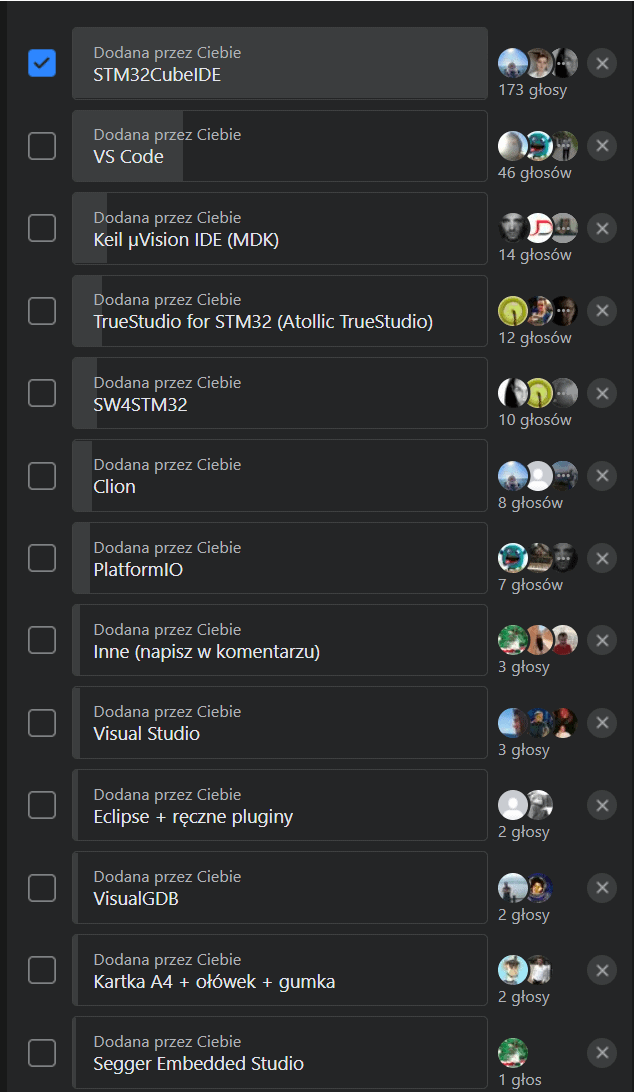
In this comparison, I omitted SW4STM32 and Atollic TreStudio. These are dead IDEs that have long not been supported. We really shouldn’t be using them.
1. STM32CubeIDE
It doesn’t surprise me that the IDE prepared by STMicroelectronics took first place. Some time ago they bought Atollic True Studio and, based on it, created a combination of Eclipse and STM32CubeMX.
Why is it so popular? You install it and it works. I love Out Of The Box tools, and I’m not the only one. I use this IDE every day, as do hundreds of programmers in Poland and around the world.
We also use this IDE in the STM32 Course for Beginners (conducted in Polish), with the 4th edition starting on February 16, 2022.
2. Visual Studio Code / PatformIO
Link to PlatformIO
I decided to combine these two environments. Visual Studio Code is an insanely popular “editor on steroids” for writing all sorts of software.
Millions of programmers use it basically for everything.
Of course, you can program STM32 microcontrollers in it. You can do it in bare VSC, or you can use PlatformIO, which is dedicated to microcontrollers. You can write both “in Arduino style” and “normally”. There’s also debugging, so it’s not a crippled solution.
To use CubeMX in PlatformIO, this plugin is useful: https://github.com/ussserrr/stm32pio
It adapts a CubeMX project to work with PlatformIO.
3. Keil µVision IDE (MDK)
An environment straight from ARM. Supposedly the best—at least that’s what many users claim. It’s not limited only to STM32. It can program all ARMs OOTB.
It has its own efficient compiler. Unfortunately, in my opinion it has two huge drawbacks:
- The interface got stuck in 1995
- It’s paid
There is a free version and it’s called MDK-Lite Edition. It used to be free without limitations for Cortex-M0 and Cortex-M0+ cores. Now there is a 32kB output code limit. As we know, STM32 programs often exceed this value, especially those written with HAL 🙂
4. CLion
If someone has worked with any JetBrains suite, they can imagine what it is.
Every IDE from them is very good. There are quite a few people programming microcontrollers in CLion, which is dedicated to C/C++.
The tool is paid, but it has a 30-day trial.
5. Segger Embedded Studio
A multiplatform IDE from Segger.
This company makes brilliant debuggers that can capture microcontroller instructions in real time. For full support of their debuggers, it is recommended to use Segger tools.
One such tool is an IDE, i.e., Segger Embedded Studio. It is cross-platform (Windows, Linux, Mac). Built-in Clang/LLVM, GCC is a plus. What’s more! It also has Segger’s C/C++ toolchain.
Worth a try. It’s free for non-commercial use.
STM32 Course for Beginners
On February 16, the best STM32 programming course for beginners returns! This is already the fourth edition! (conducted in Polish)
It’s a complete A-to-Z program in which you will learn how to program STM32 microcontrollers. You’ll get to know its interfaces and you’ll be able to use them correctly and in a non-blocking way.
Don’t miss the chance! The next edition will probably be only in the second half of 2022.
So far, more than 470 people have taken part in the course!
Sign up for the waiting list at https://kursstm32.pl/ (conducted in Polish)

Podobne artykuły





0 Comments